
Lists tell you who. Timing tells you when.
A successful sales strategy still starts with understanding who you want to work with.
A clear Ideal Customer Profile gives you the target; a well-built prospect list gives sales and marketing focus. That approach has served well and continues to do so, but it has its limitations.
A list is only ever a snapshot, a moment in time. It can tell you a great deal about a business – its size, sector, location, technology and likely decision-makers – but it can't tell you whether today is a particularly good day to start a conversation.
That matters because circumstances change.
A new Managing Director arrives. Investment is secured. Recruitment accelerates. A business enters a new market, launches a product or acquires another company. None of these events automatically creates a sales opportunity, but each can give you a reason to look again.
Really good salespeople have always understood this instinctively. They stay close to their market, notice what is changing and use that knowledge to decide where their attention is most likely to be rewarded.
In other words, they bring commercial awareness to prospecting.
Competitive advantage begins with commercial awareness
The investment-banking world offers a useful analogy…
Contacts and target lists matter enormously, but the moat successful brokers distinguish themselves through their understanding of what is moving: who is investing, where pressure is building, which sectors are consolidating and what those changes might mean.
Often the information itself is public. The advantage lies in noticing it, interpreting it and acting on it sooner. The same principle applies to business development. Information tells us what happened. Commercial awareness helps us decide what to do about it. That can change not only who a salesperson approaches, but the quality of the conversation when they do. Better context leads to better questions, more relevant examples and a clearer understanding of why a conversation might matter now.
The aim isn't to contact more people; it's to contact the right people at the right time.
Where AI becomes useful
None of this is new. Good salespeople have always built market knowledge through experience, research and strong networks. What is new is our ability to support that behaviour continuously.
AI can keep watch when people cannot, monitoring agreed signals and surfacing potentially important changes that might otherwise go unnoticed. Instead of spending hours looking for a reason to make contact, salespeople can spend more time deciding whether that reason genuinely matters – and, if it does, building the relationship.
That distinction is important.
The opportunity isn't to remove people from the process. It's to give them better intelligence and more time for the parts ofselling that genuinely benefit from human experience: listening, understanding, judgement and trust.
Technology changes remarkably quickly. Human behaviour rarely does.
Better conversations, not simply more activity
There is an understandable temptation to judge new sales technology by how much more activity it can create: more emails, more touches, more research, more leads. But if the additional activity is poorly timed or irrelevant, producing more of it more efficiently is hardly progress.
The more interesting question is whether technology helps people make better decisions about where their time is spent and what conversations are worth having.
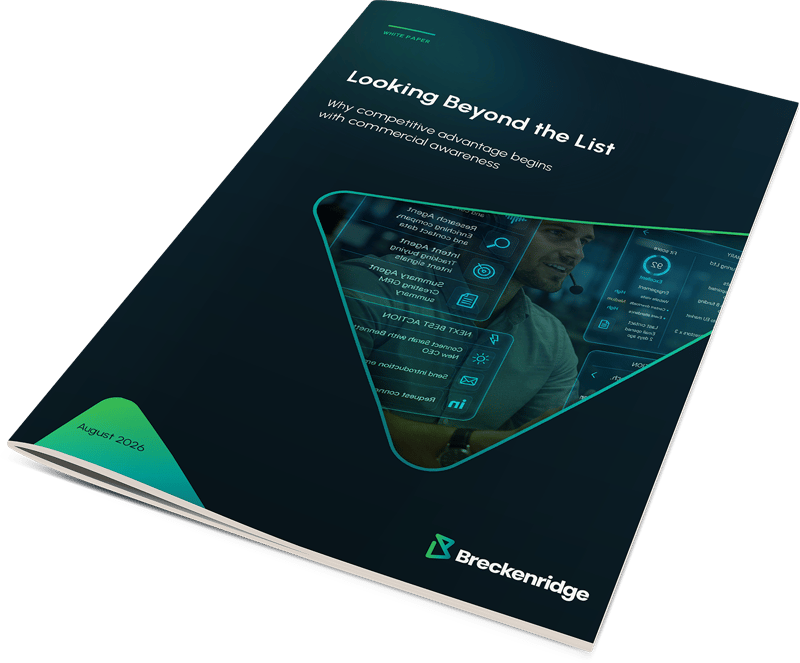
That is the idea we explore in more depth in Looking Beyond the List.
We look at how commercial awareness can become a practical part of modern prospecting, why timing and context matter, and where AI can genuinely support sales teams without trying to replace the people at the heart of good business development.
Lists tell you who. Timing tells you when.
Download the full white paper
Prospect lists are useful. But they can only tell you so much.
The real advantage comes from understanding what is happening within a business, what has changed, and why that might make a conversation relevant now.
Looking Beyond the List explores how commercial awareness, buying signals and AI-enabled prospecting can help sales teams identify the right people at the right time – with better context and a genuine reason to start a conversation.
It also looks at how AI can handle much of the monitoring and research in the background, leaving salespeople to focus on what they do best: using judgement, having conversations and building relationships.
Download Looking Beyond the List