
I've sat in more forecast calls than I care to admit where the conversation grinds to a halt because nobody can agree on what was actually sold. Sales has one version in a deal record. Finance has another in a spreadsheet that's three weeks out of date. Customer Success is working off a PDF someone emailed them eighteen months ago. Everyone's right, technically, and the business is still flying blind.
That's the gap HubSpot is going after with Revenue Hub, launching 16 June 2026. If you're running a HubSpot instance for a growing SME or mid-market business, this is worth twenty minutes of your time. Not because it's a flashy new feature or token HubSpot update, but because it's HubSpot finally building the connective tissue between the bit that wins the deal and the bit that collects the cash. This is key to refining your RevOps blueprint.
What Revenue Hub Actually Is
Strip away the launch-day language and Revenue Hub is HubSpot bringing CPQ (configure, price, quote), billing and payments into one connected system, sitting on top of a single object that didn't really exist in HubSpot before: the contract.
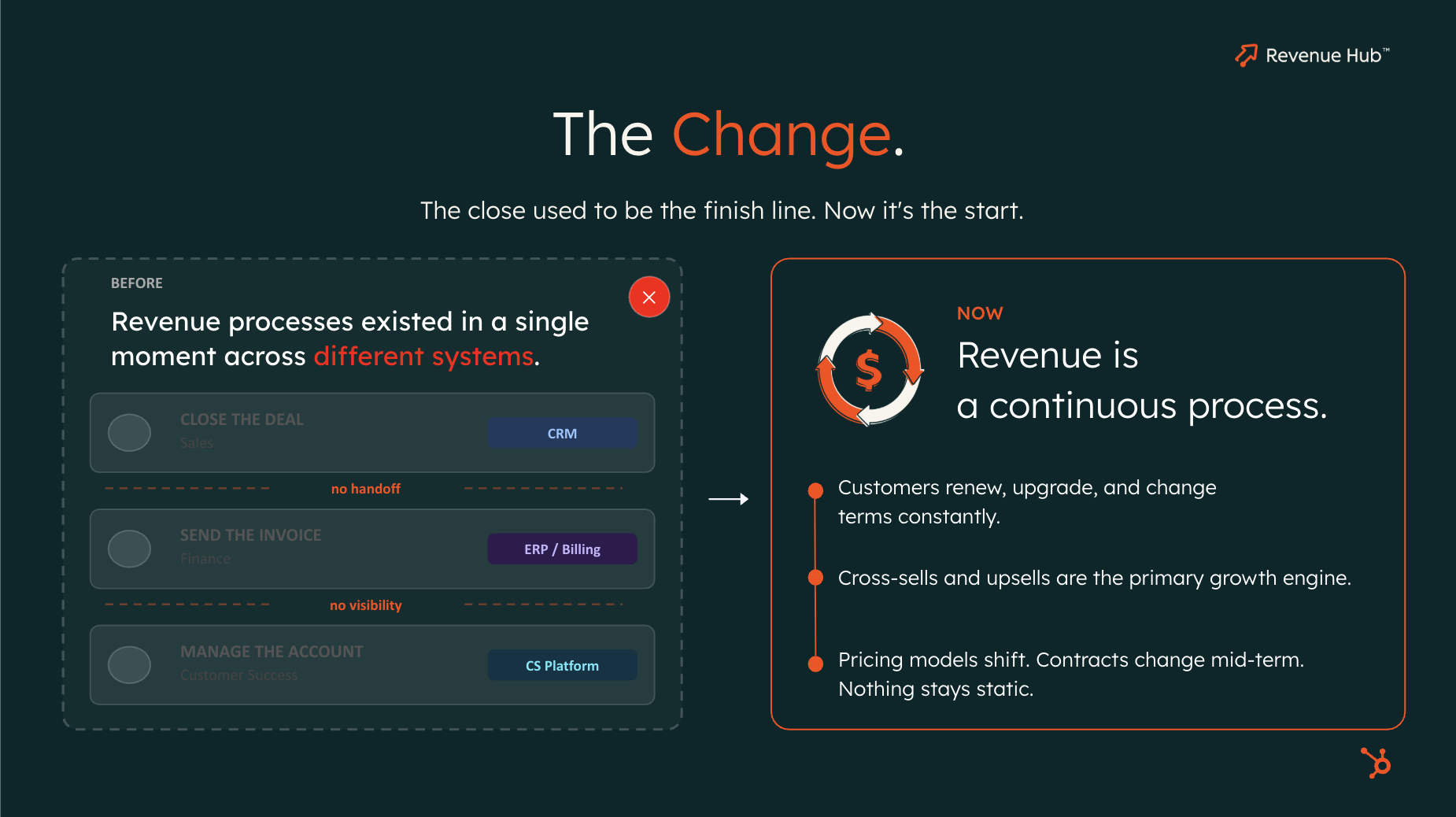
That last part is the bit I'd pay attention to. Up to now, a signed quote was the end of the story as far as most CRMs were concerned it's a static document that got filed away. Revenue Hub treats the contract as a living record. It's what was sold, at what price, for how long, and it becomes the foundation for every amendment, renewal, upsell and invoice that follows. Change the deal six months in and you're not rebuilding it from scratch; you're amending a record the whole business already shares.
If you've ever tried to explain to a CFO why "what we sold" and "what we're invoicing" don't match, you'll know why that matters.
The Problem It's Actually Solving
HubSpot's own data puts it bluntly: 86% of B2B deals stall at the quote-to-close stage because of fragmented systems and manual handoffs. I'd believe a higher number if you asked most RevOps leads privately.
This is the pattern I see constantly:
A sales rep builds a quote in one tool, or worse, in Word. It gets approved over email because there's no proper workflow. It gets signed via a separate e-signature tool. Finance then manually re-keys the terms into invoicing software, because there's no reliable link between "what was agreed" and "what gets billed." Six months later, the account manager wants to know if there's room to upsell, and has to go digging through three systems and a Slack thread to find out what the customer is even paying for today.
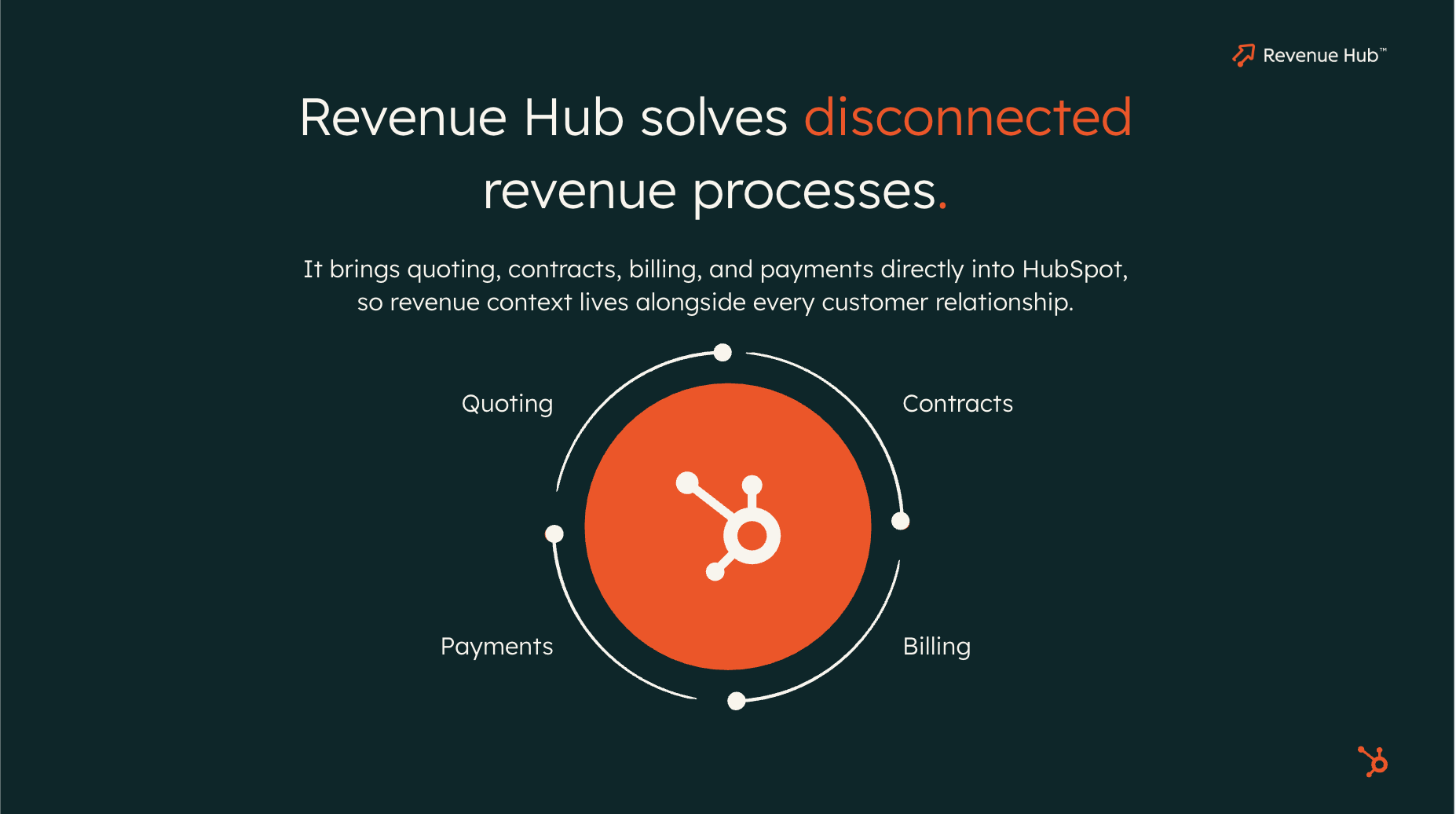
None of that is anyone's fault. It's what happens when quoting, contracts, billing and payments grow up as separate tools bolted together over time. Revenue Hub's pitch is that if those four things live in one system on one record, that whole chain of manual reconciliation just doesn't need to happen.
Why This Matters More if You're an SME or Mid-Market Business
Enterprise companies have typically solved this with heavyweight CPQ platforms (think Salesforce CPQ or DealHub) bolted onto their CRM at significant cost and with a serious implementation lift. That's never made sense for most of the businesses we work with. You don't need enterprise-grade multi-entity revenue recognition; you need your sales team to stop manually re-typing quotes into your billing system, and you need your leadership team to trust the forecast.
This is exactly the gap Revenue Hub is built for. For a SaaS business managing renewals and expansion, a professional services firm juggling project-based invoicing alongside retainers, or a B2B company tired of bolting a third-party quoting tool onto HubSpot and praying the integration holds. This is the first time HubSpot has offered a genuinely native answer, rather than something you patch together with workflows and a connector.
A few scenarios I think will land with our clients specifically:
-
The Sales Director who's sick of "where's that quote" Slack messages. With pricing rules and product bundles built into the catalogue, reps configure quotes against guardrails you've already set discount limits, mandatory product pairings, approval triggers — instead of free-handing terms and hoping finance doesn't notice later.
-
The Marketing/Ops leader who can't get a straight answer on revenue attribution. Because billing and payments status flows back into the same CRM record the deal was created in, you stop having the argument about whether a "closed-won" deal is actually generating revenue yet.
-
The Customer Success team flying blind on renewals. Renewal quotes generate directly from the existing contract record rather than starting from a blank deal. Combined with visibility into what's actually been billed and paid, CS can walk into a renewal conversation already knowing the account's full commercial history, not reconstructing it from old emails.
-
The Finance lead who dreads contract amendments. Mid-term changes, adding seats, swapping a product, adjusting a quantity it updates the existing contract and prorate automatically, rather than spinning up a brand-new deal and a parallel paper trail.
What's Live Now vs What's Coming
Worth being straight about this, because HubSpot themselves are: not everything ships on day one.
CPQ and Contracts are the foundation, available now. Billing and Payments extend onto that same contract foundation through the rest of 2026, with capabilities like milestone billing (invoicing tied to project delivery rather than fixed dates) landing later in the year. The roadmap also points to things like AI-assisted quote optimisation, price books by region or customer segment, and product bundling i.e. sensible, practical additions rather than headline-grabbing AI gimmicks.
If your business has more complex needs siuch as manufacturing bill-of-materials, usage-based pricing at real scale, multi-entity tax and revenue recognition, you may still be better served by a dedicated CPQ platform. That's a genuinely small slice of the businesses we work with, but it's worth saying plainly rather than pretending Revenue Hub is a fit for absolutely everyone on day one.
My Honest Take
I'm always cautious about anything that gets unveiled with launch-day fireworks, because the gap between "the roadmap slide" and "what actually works smoothly in your portal six months in" can be wide. But the underlying thesis here is the right one, and it's the one we bang the drum about with every client: revenue operations breaks down when the systems don't talk to each other, not because any individual tool is bad.
If your quoting, contracts, billing and payments currently live in three or four different places, with someone manually keeping them in sync, that's not a "nice to fix eventually" problem, then it's actively costing you deal velocity, finance accuracy, and almost certainly some renewals you didn't see coming.
Revenue Hub gives HubSpot customers a genuine native path to close that gap, without bolting on another platform and another integration to maintain.
Want some help with Revenue Hub for your company?
As HubSpot Diamond Partners we'll be getting hands-on with Revenue Hub as it rolls out and will be helping our clients work out exactly where it fits in their stack. If you want to talk through what a connected quote-to-cash process could look like for your business, get in touch and we'll have an honest conversation about it.
