

Executive summary
Successful HubSpot implementation is rarely constrained by the software itself. The biggest factor influencing implementation timelines is organisational alignment.
While smaller or less complex businesses may complete onboarding relatively quickly, implementations become more nuanced when multiple teams, customer journeys, integrations, or operational processes are involved. In these environments, CRM deployment shifts from a technical setup exercise to a broader business transformation initiative.
The organisations that achieve the strongest outcomes are typically those that approach onboarding strategically - allowing time for process design, stakeholder alignment, reporting decisions, data governance, and user adoption planning.
Rather than asking, “How quickly can HubSpot be configured?”, businesses should focus on a more important question:
How quickly can the organisation align around how it wants to operate?
A phased implementation approach often delivers stronger long-term results than compressed, all-at-once deployments.
Why CRM implementation timelines vary
One of the most common conversations we have with prospective clients starts with a fixed deadline.
A business wants to be live on HubSpot by September. The ambition is clear, the internal momentum is there, and the need for change is genuine. But procurement takes longer than expected, internal stakeholders need sign-off, and priorities shift. By the time onboarding discussions become implementation reality, it’s already late July.
At that point, the pressure begins.
Not because HubSpot is difficult to deploy, but because successful CRM implementation has very little to do with simply “switching on” a platform. The challenge is rarely the technology itself. It’s the organisational complexity sitting behind it.
This is where many businesses underestimate what onboarding actually involves.
A modern CRM implementation is not a software exercise. It’s a business transformation project that touches process, reporting, customer experience, sales behaviour, marketing operations, data quality, and internal alignment - often all at once.
That’s why timelines vary so dramatically between organisations.
A relatively straightforward rollout for a smaller sales team can often move quickly. But once multiple departments, customer journeys, regions, or service lines are involved, onboarding becomes significantly more nuanced. What initially looks like a six-week project can rapidly evolve into a multi-phase implementation requiring months of strategic and operational work.
The businesses that navigate this well are usually the ones that recognise early that CRM projects are less about configuration and more about decision-making.
The decisions that slow or accelerate onboarding
Before a single workflow is built, fundamental questions need answering.
-
How should leads move through the organisation?
-
What defines a qualified opportunity?
-
Which team owns the customer relationship at each stage?
-
What should reporting actually measure?
-
Where does marketing end and sales begin?
-
Which processes are genuinely scalable, and which are simply historical workarounds that have become embedded over time?
These conversations are often where implementation timelines are won or lost.
Technology can usually be configured relatively quickly. Alignment takes longer.
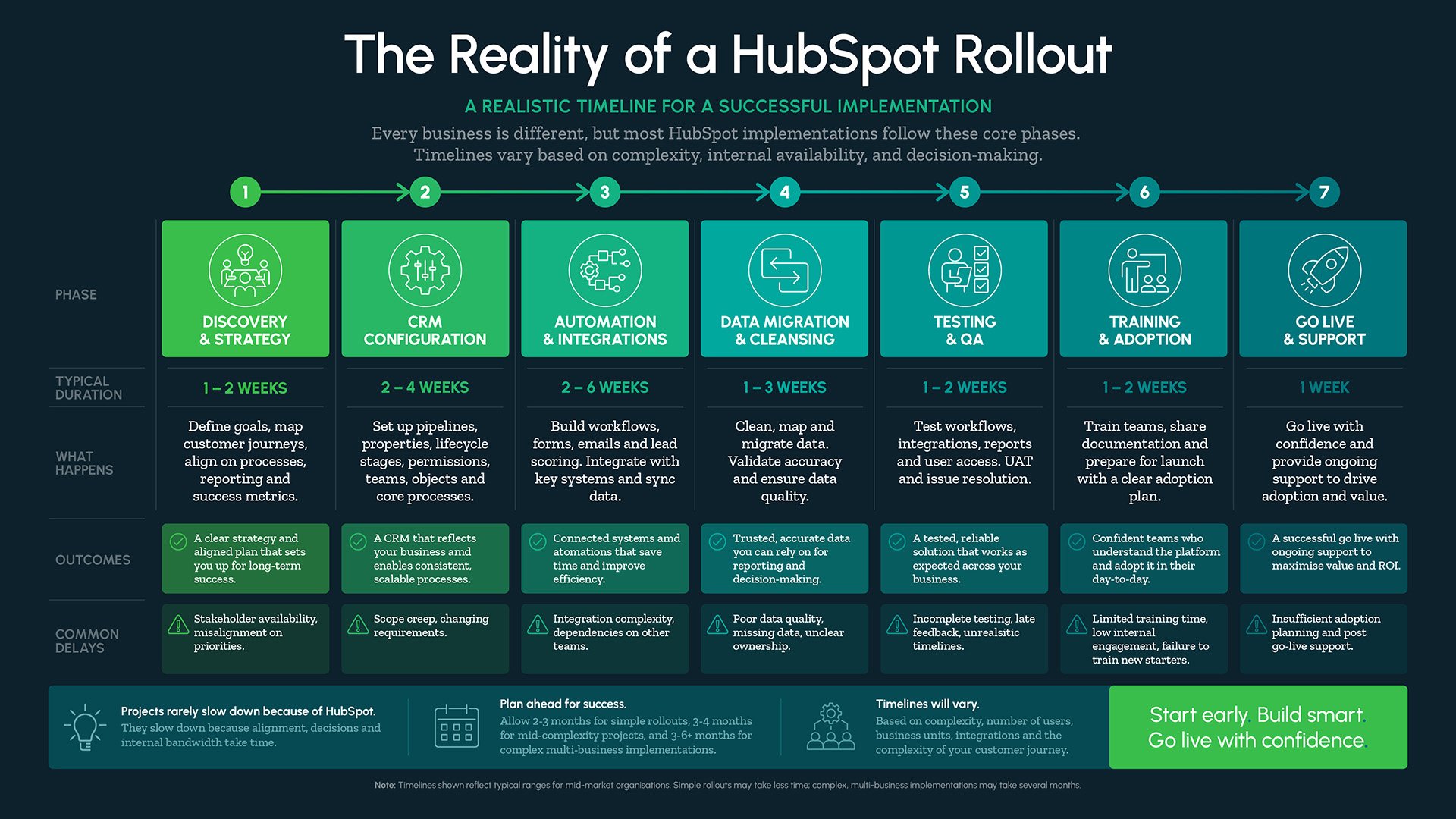
This becomes particularly visible in larger or more mature organisations. Different teams frequently operate with different definitions, processes, and expectations. Sales may want flexibility. Marketing may want attribution accuracy. Service teams may prioritise operational visibility. Leadership may focus on forecasting and reporting consistency.
None of these priorities are wrong, but bringing them together inside a single platform takes careful planning.
Three key areas to consider are:
1. The customer journey
Businesses with relatively linear sales processes tend to move faster because the required automation and reporting structures are more predictable. But organisations operating across multiple service lines, long buying cycles, or complex account structures often need significantly more strategic design before implementation can begin. The CRM has to reflect not only how the business works today, but how it intends to scale tomorrow.
2. Technical integrations
Integrations create another layer of complexity that is routinely underestimated.
Many organisations now operate with deeply interconnected technology ecosystems. Systems such as finance software, customer support platforms, and operational databases often need integrating into HubSpot. Integrating these systems is rarely just a technical challenge. It requires decisions around ownership of data, process dependencies, governance, and reporting logic.
And then there’s the issue that quietly slows down more onboarding projects than almost anything else.
3. Internal availability
Even highly motivated organisations often struggle to dedicate the time implementation requires. Workshops get postponed. Feedback loops slow down. Stakeholders disagree on priorities. Critical decisions sit waiting for approval while target go-live dates continue getting closer.
Ironically, the organisations most eager to move quickly are sometimes the ones that inadvertently create the biggest delays.
Why rushed implementations create problems later
This is why implementation timelines should never be viewed purely through the lens of software delivery. The real question is not “How fast can HubSpot be set up?” but “How quickly can the organisation align around the way it wants to operate?”
That distinction matters because it changes how businesses approach planning.
When onboarding is treated as a strategic project rather than a procurement exercise, timelines become more realistic. There is more room for proper discovery, cleaner data migration, stronger user adoption, and more sustainable process design. Teams have time to challenge assumptions instead of simply recreating old inefficiencies inside a new platform.
By contrast, compressed implementations almost always force compromise somewhere.
Sometimes functionality gets pushed into a later phase. Sometimes reporting launches incomplete. Sometimes training becomes rushed. And occasionally businesses go live with processes that technically function but fail to gain internal adoption because teams never had the opportunity to properly engage with the change.
None of this means implementations need to become unnecessarily slow or over-engineered. In fact, phased rollouts are often the most effective approach. The strongest CRM programmes are rarely those that attempt to deliver every possible feature on day one. They are the ones that establish a stable operational foundation first, then evolve iteratively as the business matures.
That approach requires a shift in mindset.
The businesses that get the most value from HubSpot tend to start planning earlier than they think they need to - not because implementation itself always takes months, but because organisational readiness usually does.
Final thoughts
Ultimately, successful onboarding is not determined by how quickly contracts are signed or workflows are configured. It’s determined by how effectively the business uses the implementation window to align people, processes, systems and data, around a shared operational model.
And that simply takes time.
Key takeaways
-
HubSpot implementation is primarily an organisational alignment exercise, not a technical deployment
-
Timelines vary based on complexity, not the tool itself
-
Most delays come from decision-making, not configuration
-
Alignment across teams is usually the slowest and most critical phase
-
Integrations and internal availability are often underestimated constraints
-
Compressed timelines increase the risk of poor adoption and incomplete processes
-
Phased implementations typically deliver stronger long-term outcomes
-
The real success factor is how quickly an organisation can agree how it wants to operate
